


Cashmere wins for lightweight warmth and next-to-skin luxury; merino wins for performance, breathability and everyday durability. Neither fibre is objectively superior — the right choice depends on function. Here are three quick rules to guide you:
- Choose merino for active wear, travel layers, base layers and anything worn in wet or variable UK weather.
- Choose cashmere for next-to-skin luxury knitwear, formal occasions and lightweight warmth without bulk.
- Choose fine merino when budget matters and longevity is a priority; invest in Grade A cashmere only when you can commit to careful maintenance.
One caveat worth stating plainly: quality varies enormously in both fibres. A £40 “cashmere” jumper and a £400 one are not the same product. Grade and micron count matter far more than the fibre name on the label.
Table of Contents
- What is cashmere, and where does it come from?
- What is merino wool, and how does grade affect comfort?
- How do cashmere and merino compare across the dimensions that matter?
- How to care for cashmere and merino at home
- Where do these fibres come from, and what is the environmental picture?
- Which fibre should you choose for specific garments and UK situations?
- Lashra’s take on cashmere and merino in our collections
- Key takeaways
- Balancing practicality and luxury in a real wardrobe
- Discover Lashra’s knitwear collection
- Further reading and useful references
What is cashmere, and where does it come from?
Cashmere comes from the soft undercoat of cashmere goats, primarily bred across Mongolia, China’s Inner Mongolia region and parts of Iran and Afghanistan. The fibre is collected once a year in spring, either by hand-combing or shearing, and the usable yield per animal is remarkably small.
Key fibre characteristics:
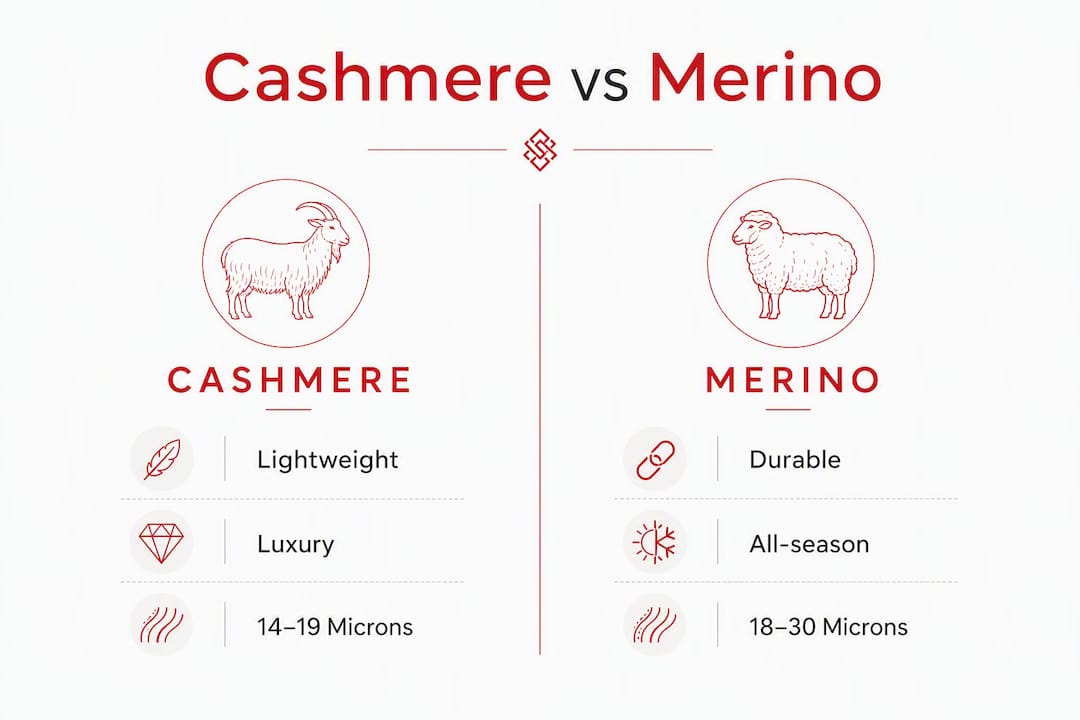
- Fibre diameter: typically 14–19 microns, placing it among the finest natural fibres available.
- Staple length: shorter than merino, which contributes to cashmere’s legendary softness but also its tendency to pill over time.
- Loft and warmth-to-weight: the fine, hollow structure traps air exceptionally well, giving cashmere a warmth-to-weight ratio that few fibres can match.
- Yield: it takes fibre from at least two goats to produce a single two-ply cashmere sweater, which explains why genuine quality cashmere commands a premium price.
Grading matters enormously. Grade A cashmere uses the longest, finest fibres (typically 14–15.5 microns) and lasts decades with proper care. Lower grades use shorter fibres that pill quickly and lose their softness within a season or two. When you see cashmere priced below what feels reasonable, shorter fibres are almost certainly the reason.
What is merino wool, and how does grade affect comfort?

Merino wool comes from Merino sheep, a breed originally from Spain but now raised predominantly in Australia and New Zealand. Unlike cashmere goats, Merino sheep are shorn annually and produce a generous yield, which keeps supply more consistent and prices more accessible.
Key fibre characteristics:
- Fibre diameter: merino typically falls under 22 microns, with superfine grades running as low as 15–17.5 microns. For context, human hair averages 50–100 microns.
- Crimp structure: merino’s natural crimp creates tiny air pockets that provide insulation, and the spring-like structure gives the fibre exceptional elasticity and shape recovery.
- Grade variation: superfine merino (under 18.5 microns) is genuinely next-to-skin soft; medium grades (19–22 microns) suit outerwear and heavier knits where durability matters more than delicacy.
The Woolmark organisation describes merino as the world’s premier natural apparel fibre, and that reputation is grounded in its versatility across temperature ranges. Merino is not purely a winter fabric. Its ability to regulate your body’s microclimate means it performs in warm conditions as well as cold, which is why it appears in everything from hiking base layers to lightweight city knitwear.
Fibres above roughly 30 microns are more likely to cause that familiar prickling sensation against skin. Both cashmere and fine merino sit well below that threshold, which is why both feel comfortable next to skin when correctly graded.
How do cashmere and merino compare across the dimensions that matter?
The honest answer is that each fibre wins in different categories. Here is the full picture:
| Dimension | Cashmere | Merino |
|---|---|---|
| Warmth / insulation | Excellent warmth-to-weight; lighter feel for equivalent warmth | Very good; heavier gauge needed for equivalent warmth |
| Softness / hand feel | Exceptionally soft; finer average micron | Soft at superfine grades; coarser at medium grades |
| Durability / pilling | Shorter staple = more prone to pilling; Grade A lasts decades | Longer staple and crimp = better elasticity and shape retention |
| Moisture management | Absorbs moisture but slower to release; not ideal for active wear | Transports moisture as vapour before it becomes liquid sweat; excellent for active use |
| Weight / layering | Lightweight; ideal as a single luxury layer | Versatile across weights; excellent for base and mid-layers |
| Price & value | Higher entry cost; Grade A offers long-term value | More accessible; fine merino offers strong cost-to-wear ratio |
| Care complexity | Hand wash recommended; flat dry; more fragile | Many treated merino garments are machine-washable |
| Sourcing / sustainability | Environmental concerns around overgrazing in Mongolia/China | Certified Australian/NZ merino has strong traceability options |
A few points worth expanding:
- Warmth: cashmere’s finer micron range gives it a warmth-to-weight advantage, so a lightweight cashmere jumper can feel warmer than a heavier merino knit. For UK winters, that matters when you want warmth without bulk under a coat.
- Durability: merino’s longer staple and crimped structure give it better elasticity and shape retention than cashmere. A merino base layer will outlast a cashmere one under repeated active wear.
- Moisture: merino’s hygroscopic nature means it manages moisture vapour effectively, keeping you drier during exertion. Cashmere absorbs moisture too, but it is not designed for performance use.
- Price reality: cheap cashmere often uses short fibres that pill quickly; Grade A long-staple cashmere, cared for well, lasts decades. Fine merino at a mid-price point frequently delivers more practical value per wear for everyday pieces.
Pro Tip: When shopping either fibre, check the micron count on the label if it is listed. For cashmere, look for Grade A or a stated micron of 15–16. For merino, “superfine” or “ultrafine” on the label indicates the softest, most next-to-skin-friendly grades. A two-ply construction in either fibre adds durability without sacrificing softness.
How to care for cashmere and merino at home
Good care extends the life of both fibres significantly. The key difference is that merino is more forgiving; cashmere rewards patience.
Washing step by step
- Check the label first. Many merino garments carry a machine-wash symbol; cashmere almost always recommends hand washing.
- For cashmere: fill a basin with cool water (under 30°C) and add a small amount of gentle wool wash or baby shampoo. Submerge the garment and gently squeeze the water through. Never wring or rub.
- For merino (hand wash): use the same cool-water method. For machine-washable merino, use a wool or delicate cycle at 30°C with a wool-specific detergent.
- Rinse carefully with water at the same temperature to avoid thermal shock, which can cause felting.
- Remove excess water by pressing the garment gently against the side of the basin, then rolling it in a clean towel.
Drying and reshaping
- Always dry both fibres flat on a clean towel, reshaping to the original dimensions while damp.
- Never hang a wet knit — the weight stretches the shoulders permanently.
- Keep both away from direct heat sources and sunlight while drying.
Storage and moth prevention
- Fold knitwear; never hang it long-term.
- Store in breathable cotton bags or pillowcases rather than sealed plastic.
- Cedar blocks or lavender sachets deter moths without the chemical residue of mothballs.
- Clean garments before storing — moths are attracted to body oils and food residue, not the fibre itself.
Pro Tip: Both cashmere and merino naturally resist odour and can be refreshed simply by airing on a hanger overnight. Washing less frequently preserves the knit structure and extends the life of the garment considerably.
For de-pilling, a fabric comb or a dedicated cashmere comb works well on both fibres. Use light, short strokes on a flat surface. If a garment has felted or the knit structure has distorted significantly, a professional textile cleaner is worth the cost.
Where do these fibres come from, and what is the environmental picture?
Geography shapes both quality and environmental impact, and it is worth understanding both before you buy.
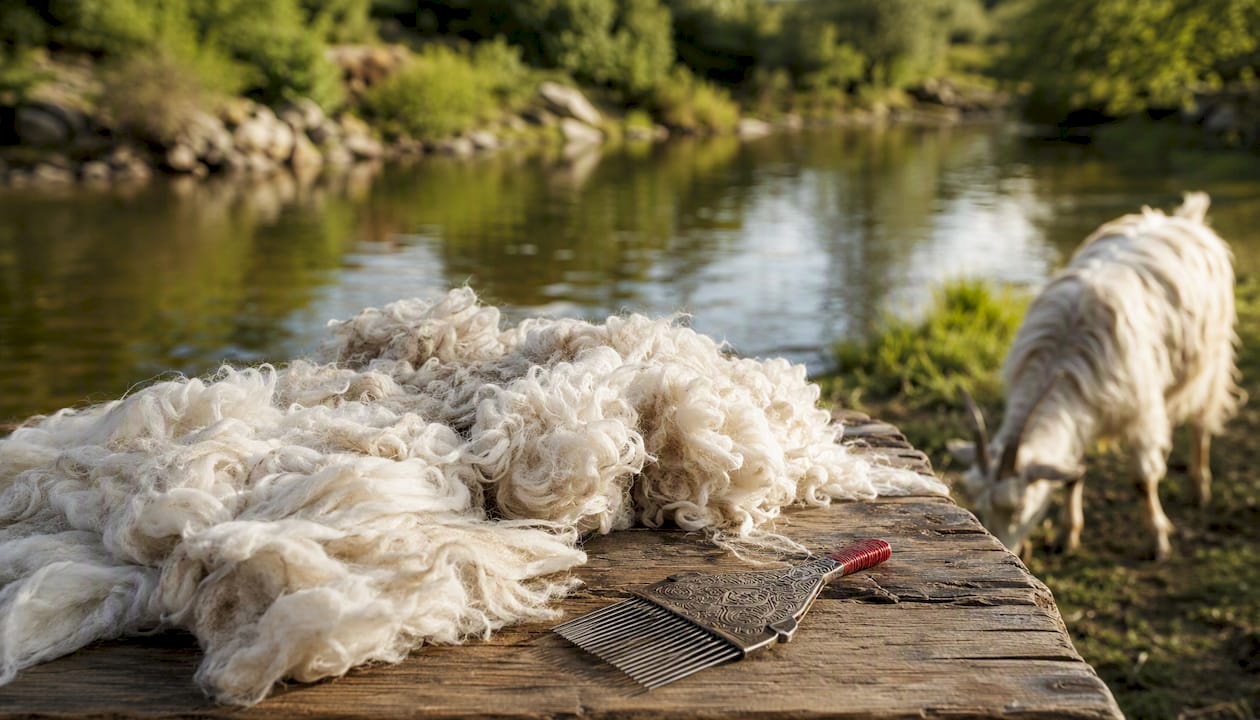
Cashmere is produced primarily in Mongolia and China’s Inner Mongolia region, with smaller quantities from Iran, Afghanistan and Scotland. Mongolian cashmere is widely regarded as among the finest, partly due to the extreme temperature range the goats endure, which encourages a particularly fine, dense undercoat. However, sustainability concerns are real: rapid growth in global cashmere demand has contributed to overgrazing and land degradation across the Mongolian steppe. More goats on the same land means thinner, shorter fibres over time and genuine ecological pressure.
Merino is produced at scale in Australia and New Zealand, where established farming practices and strong regulatory frameworks support more consistent traceability. Australian Merino wool in particular has well-developed certification infrastructure.
Certifications and labels to look for when shopping in the UK:
- Responsible Wool Standard (RWS): covers sheep welfare and land management for merino and other wool types.
- Good Cashmere Standard (GCS): addresses animal welfare and environmental impact in cashmere production.
- ZQ Merino: a New Zealand-based programme covering fibre quality, animal welfare and environmental responsibility.
- Country of origin labelling: “Made in Mongolia” or “Mongolian cashmere” on a label is a positive signal, though not a guarantee of grade.
Choosing certified cashmere or RWS-certified merino is the single most practical step a UK shopper can take to support better farming practices. Certification does not guarantee perfection, but it does mean an independent body has assessed the supply chain — which is more than most unlabelled garments can offer.
Which fibre should you choose for specific garments and UK situations?
Translate the comparison into practical buying decisions:
Choose merino for:
- Hiking, running and active base layers — its moisture-wicking and temperature-regulating properties are unmatched among natural fibres.
- Travel knitwear — merino resists odour, packs light and recovers its shape after being folded in a bag.
- Everyday office or casual knits where you need durability and easy care.
- Layering under a coat in changeable UK weather, where its ability to insulate even when damp is genuinely useful.
Choose cashmere for:
- A luxury next-to-skin jumper for city wear or special occasions.
- Lightweight warmth when you want to avoid bulk under tailoring.
- A considered investment piece — a Grade A high-neck cashmere jumper worn and cared for properly will outlast many cheaper alternatives.
- Gifts, where the tactile luxury of the fibre speaks for itself.
Label checklist before you buy
- Micron or grade: look for Grade A, superfine, or a stated micron count below 16 for cashmere; “superfine” or under 18.5 microns for merino.
- Ply: two-ply construction adds durability in both fibres without sacrificing softness.
- Country of origin: Mongolia or Scotland for cashmere; Australia or New Zealand for merino are the strongest provenance signals.
- Pure vs blended: a “cashmere blend” with a low percentage of cashmere will not perform like pure cashmere. Check the fibre composition percentage.
- Care symbols: a hand-wash symbol on cashmere is normal; a machine-wash symbol on merino is a genuine convenience advantage.
- Price as a red flag: cashmere priced significantly below market rate almost always uses short, low-grade fibres that pill within weeks.
Budget guidance: for everyday knitwear, fine merino at a mid-price point offers a better cost-to-wear ratio than budget cashmere. Reserve your cashmere budget for one or two well-chosen pieces in Grade A quality. A single excellent cashmere jumper worn for a decade is better value than three cheap ones replaced every season.
Lashra’s take on cashmere and merino in our collections
At Lashra, we think about fibre choice the same way we think about fit: it should work for your life, not just look good on a hanger. Our knitwear range reflects that philosophy, with pieces chosen for both their tactile quality and their wearability across real UK days.
We favour Italian-crafted knits for their construction quality and fibre integrity. Whether you are drawn to the cloud-like warmth of a fine knit or the structured drape of a heavier Italian piece, the garments we select are chosen to hold their shape, feel good against skin and reward careful care.
For customers who love the luxury of fine knitwear, our women’s knitwear collection includes pieces that sit beautifully whether worn alone or layered. Our Italian-made knits, including the oversized tassel poncho and the chunky knit batwing jumper, are constructed with stitch density and drape in mind — the kind of details that separate a garment you wear once from one you reach for every week.
Our care guidance for knitwear customers:
- Hand wash or use a delicate machine cycle at 30°C with a gentle detergent.
- Dry flat, reshaping while damp.
- Store folded in a breathable bag with a cedar block.
- Air between wears rather than washing after every use.
We offer free shipping on orders over £50 and hassle-free returns, so if a piece does not feel right when it arrives, returning it is straightforward.
Key takeaways
Merino is the practical, durable, all-season choice; cashmere is the luxury, lightweight option — and grade determines whether either fibre actually delivers on its promise.
| Point | Details |
|---|---|
| Warmth-to-weight | Cashmere’s 14–19 micron fibre gives superior warmth-to-weight; merino needs a heavier gauge for equivalent warmth. |
| Durability and care | Merino’s crimp and longer staple make it more resilient and easier to wash than cashmere. |
| Moisture performance | Merino transports moisture as vapour, making it the better choice for active wear and variable UK weather. |
| Grade over price | Cheap cashmere uses short fibres that pill fast; Grade A long-staple cashmere lasts decades with proper care. |
| Lashra knitwear | Lashra’s Italian-crafted knitwear collection offers quality construction in styles suited to both luxury and everyday wear. |
Before buying, always check micron count, ply, country of origin and fibre composition percentage on the label.
Balancing practicality and luxury in a real wardrobe
The conventional wisdom tends to frame this as a competition, but we find the most satisfying wardrobes treat cashmere and merino as partners rather than rivals. Merino earns its place in the everyday rotation: it handles the commute, the weekend walk, the unpredictable British drizzle. Cashmere is the piece you reach for when you want to feel genuinely dressed, whether that is a dinner, a family occasion or simply a Sunday when you want something that feels considered.
The practical pairing advice we return to: invest in two or three excellent merino pieces for regular wear and one or two Grade A cashmere pieces for occasions. Rotate them, air them between wears, and wash them less than you think you need to. Both fibres reward that kind of attention with longevity that fast-fashion alternatives simply cannot match. The cost-per-wear calculation, when you run it honestly, almost always favours quality natural fibres over cheaper synthetic alternatives replaced every season.
Discover Lashra’s knitwear collection
If this comparison has you thinking about refreshing your knitwear wardrobe, Lashra’s women’s knitwear collection is a natural next step. We bring together Italian-crafted knits, relaxed silhouettes and inclusive sizing so you can find a piece that genuinely fits your style and your life.

Our Italian-made pieces are constructed with the kind of stitch density and drape that makes a real difference to how a knit wears and holds over time. Whether you are drawn to a cosy oversized style for winter or a lighter knit for layering through spring, the collection covers both. And because we know that buying knitwear online requires a little faith, our hassle-free returns and free shipping over £50 mean you can shop with confidence. Browse the collection and find your next favourite piece — or pair a new knit with our Magic Stretch Cargo Pants for an effortlessly put-together everyday look.
Further reading and useful references
These sources offer authoritative detail on fibre science, sustainability standards and care guidance:
- Woolmark: Wool Fibre Properties — the industry’s leading authority on merino wool science, covering micron measurement, crimp, moisture management and care. Useful for understanding the technical claims behind merino’s performance benefits.
- The Conversation: The science of merino wool explained — an accessible, peer-reviewed explainer on why merino resists odour, regulates temperature and feels soft against skin. Good background reading for anyone who wants to understand the fibre beyond marketing claims.
- Woolmark: The science behind the wool fibre — detailed breakdown of fibre structure, odour resistance and moisture management; the source behind several care and performance claims in this article.
- Lashra women’s knitwear collection — browse Lashra’s current knitwear range, including Italian-made knits and relaxed everyday styles, to see how fibre and construction choices translate into wearable garments.
- Lashra coats and jackets — useful if you are thinking about layering knitwear under outerwear, with guidance on pairing weights and silhouettes for UK weather.